
History
The use of vinegar has been known since ancient civilisations; there are numerous literary references, from Virgil in his Georgics, who already describes ‘the custom of cooking must’, to Apicius, who documents the use of cooked must in food preparation, up to the era of the Dukes of Este, Lords of Ferrara and Modena.
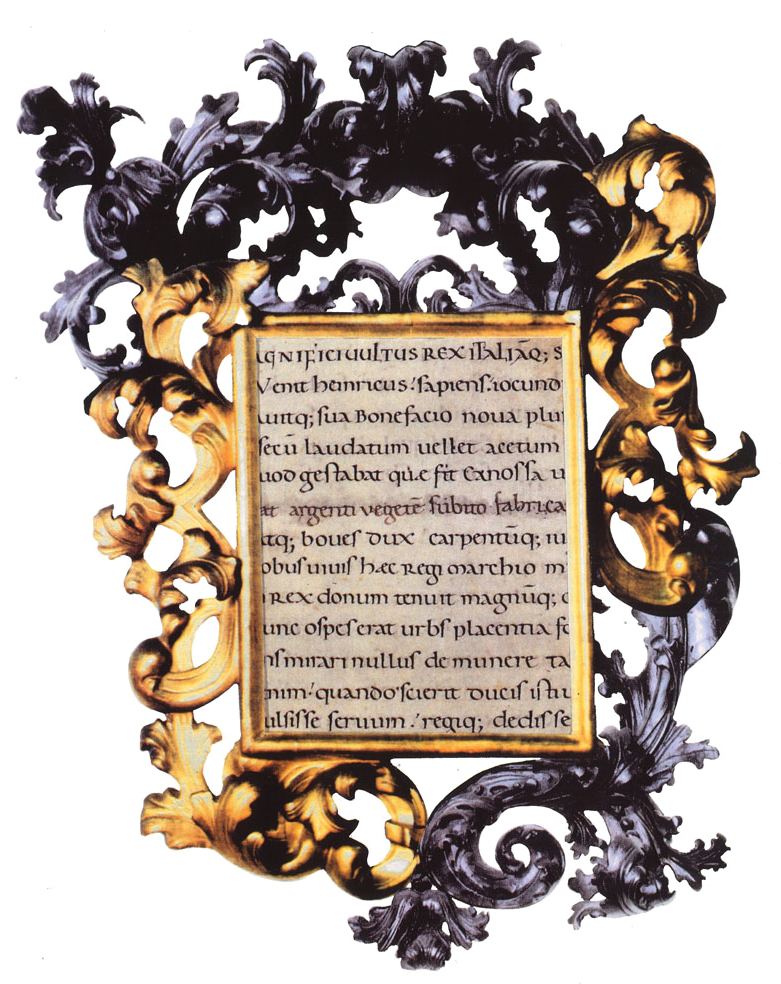
DONIZONE, Vita Mathildis; Book I, Chapter XIII, lines 979–998.
It tells of “that famous vinegar” that the Marquis of Tuscany Bonifacio sent to King Henry III, the future Emperor of Germany, along with other goods. The king, travelling to Rome to be crowned by the Pope, had stopped in the city of Piacenza and greatly appreciated that grand and magnificent gift.
Letter accompanying the vinegar sent by Marquis Bonifacio to King Henry II – September 1046
The custom of giving balsamic vinegar as a precious gift to people of importance continues as it did in the days of Henry III. Ancient memories take us back to when a bottle of the finest balsamic vinegar was given to the family doctor or solicitor.
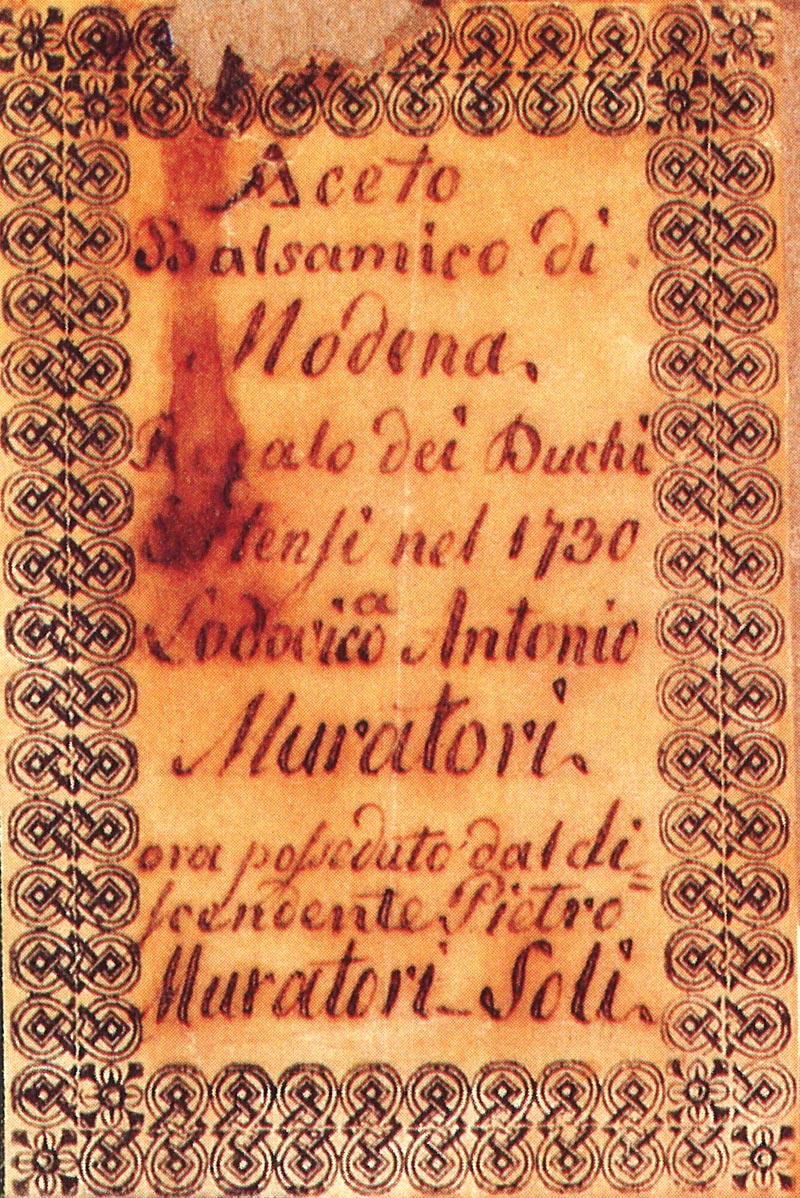
In 1730, Duke Rinaldo I d'Este and Duchess Carlotta Felicita of Brunswick gave an ampoule to Lodovico Antonio Muratori (1672–1750), historian and director of the Estense Library, in recognition of his work. It seems that the distinguished historian treated this gift, as was his professional habit, like a precious book, to be preserved for posterity so that its contents and essence could be understood.
The gift of balsamic vinegar from Duke Rinaldo I d'Este – Year 1730
At the end of the 16th century, the city of Modena had become the capital of the Duchy of Este. Several documents from that period and later explicitly attest to the ducal court's interest in the family's traditional balsamic vinegar as an “enrichment” for their tables and as a rare gift for important figures.
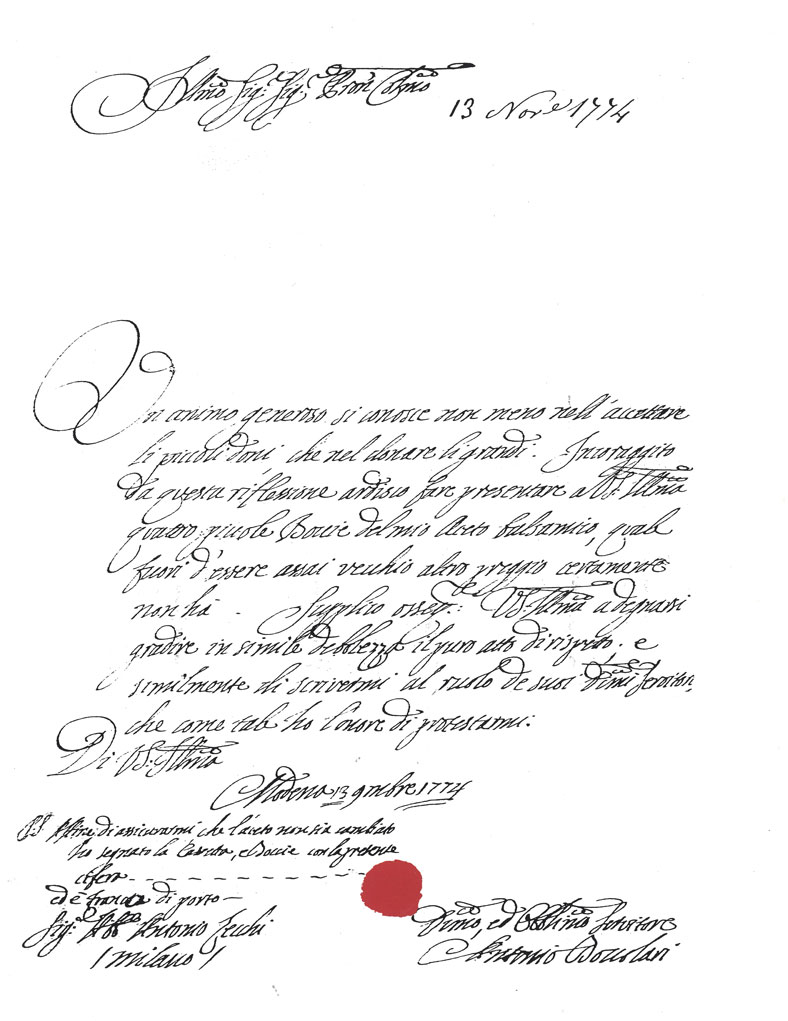
“Your Excellency, 13 September 1774 A generous spirit is recognised not only in accepting small gifts, but also in giving large ones. Encouraged by this reflection, I venture to present to Your Excellency four small bottles of my balsamic vinegar, which, apart from being very old, has no other merit. I humbly beg Your Excellency to deign to accept this small token of respect and to write to me at the address of your devoted Modena, 13 November 1774 P.S. In order to ensure that the vinegar has not changed, I have marked the box and bottles with this number and it is postage free.
Letter from Antonio Boccolari to Antonio Tecchi, 13 November 1774
Evidence of balsamic vinegar use increases in the nineteenth century, as can be seen by consulting the dowry lists of noble families in Reggio Emilia. At the time, it was customary to enrich the dowry of a woman about to marry with jars of fine balsamic vinegar and sets of small barrels containing the precious “black gold”.
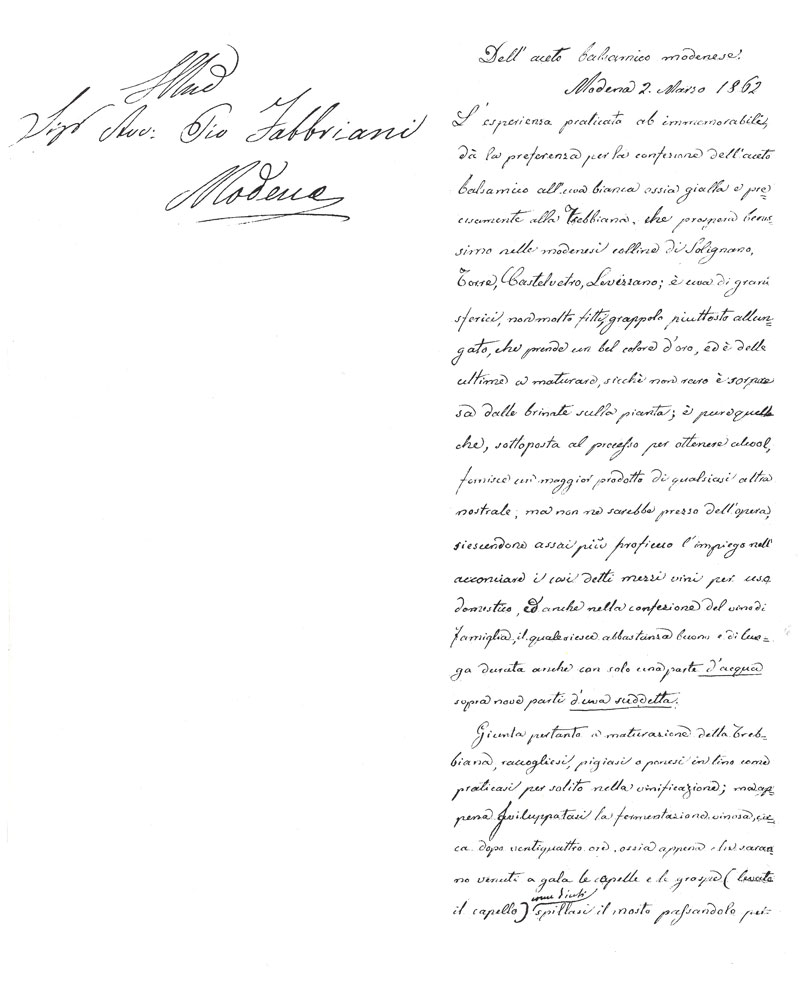
A milestone was the letter that lawyer Francesco Agazzotti wrote in 1862 to his friend Pio Fabriani, in which he described in detail the procedure for producing balsamic vinegar according to family tradition. This letter became a handbook for the people of Modena on how to care for and run their vinegar cellars.
Modena balsamic vinegar (Modena, 2 March 1862) Experience gained since time immemorial has led to a preference for making balsamic vinegar from white or yellow grapes, specifically Trebbiana, which thrives in the Modena hills of Solignano, Torre, Castelvetro, and Levizzano. It is a grape with spherical berries, not very dense, in rather elongated bunches, which takes on a beautiful golden colour and is one of the last to ripen, so it is not uncommon for it to be surprised by frost on the vine. It is also the variety that, when subjected to the process of obtaining alcohol, yields a greater product than any other local variety, but this would not be worth the effort, as it is much more profitable to use it in the preparation of so-called “mezzi vini” (half wines) for domestic use and also in the production of family wine, which is quite good and long-lasting even with only one part water to nine parts of the aforementioned grapes. Therefore, when the Trebbiana grapes are ripe, they are harvested, pressed, or placed in vats as is usually done in winemaking; but as soon as the wine fermentation has developed, after about twenty-four hours, that is, as soon as the skins and stalks have risen to the surface (the cap has been removed), as they say, the must is tapped and passed through a not very fine sieve or wicker basket...
Letter from lawyer Francesco Aggazzotti – 2 March 1862
Today, the production methods that have been handed down over the centuries with love and passion have been transcribed into the Production Regulations. The products are checked by authorised certification bodies, which guarantee their authenticity.
Find out more about the Consorzio Produttori Antiche Acetaie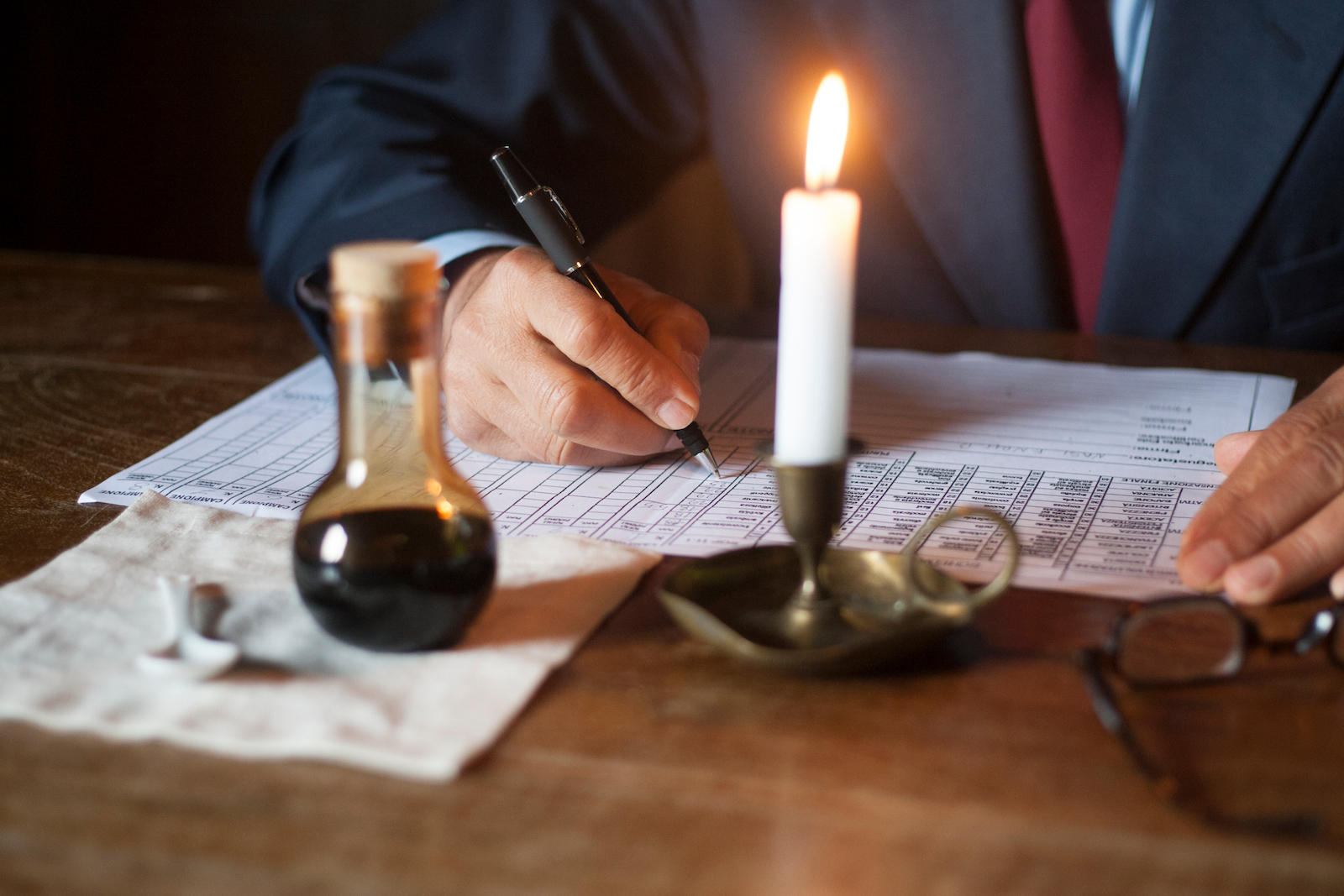
 Informazioni progetto SRG10